Table of contents
Factories are under pressure: energy costs remain volatile, skilled labor is scarce, and customers expect shorter lead times without quality slipping. In that context, the “hidden” parts of a plant, how equipment is assembled, moved, and integrated, are becoming a frontline efficiency issue, not a backroom engineering detail. Modular skid solutions, once associated mainly with niche process packages, are now reshaping industrial projects by compressing schedules and reducing on-site risk, and by turning installation into a repeatable, measurable operation.
Why plant managers are betting on skids
Less downtime, fewer surprises. That is the promise that keeps drawing plant managers toward skid-based design, especially in industries where every hour offline has a clear price tag, from chemicals and life sciences to food processing and energy. A skid, in practical terms, is a preassembled unit, piping, valves, instruments, structural frame, sometimes electrical and automation, designed to be tested before it ever reaches the plant. Instead of building an assembly on the shop floor while coordinating multiple trades in tight spaces, teams increasingly aim to “plug in” a proven module, then scale that logic across the facility.
The efficiency gain is not just a slogan; it comes from shifting work from the field to controlled fabrication environments. Field labor is expensive, weather-dependent, and exposed to permit constraints, safety coordination, and variable workmanship. Prefabrication improves repeatability and makes quality assurance more systematic, because weld procedures, pressure tests, and instrument calibration can be done under standardized conditions. In many projects, the largest schedule risk is not equipment lead time but integration, the long chain of handoffs between mechanical completion and commissioning. Skids shorten that chain by bundling interfaces, clarifying responsibilities, and allowing earlier factory acceptance testing.
Data from modular construction studies regularly show measurable schedule compression when more work is shifted off-site. In its widely cited comparisons of modularization outcomes, the Construction Industry Institute has reported that well-executed modular approaches can reduce overall project schedules by double-digit percentages, while also cutting on-site labor hours and improving safety performance, a combination that becomes compelling when plants are expanding under tight market windows. The logic extends beyond megaprojects: smaller industrial upgrades, where shutdown windows may be counted in days, benefit from the same principle, build and verify off-site, install fast, restart sooner.
There is also a strategic element: skids turn capacity additions into something closer to a repeatable product. When companies plan multi-site rollouts, adding similar lines in different geographies, they can standardize skid designs and treat integration like a template rather than a one-off engineering adventure. That standardization is what enables benchmarking, lessons learned, and incremental improvement, because teams can compare modules like-for-like, track failure modes, and refine layouts over successive builds. For decision-makers who now think in terms of total cost of ownership, not only upfront capex, that ability to learn and improve across projects is a quiet but powerful shift.
The time savings start before the site
What if speed is decided in the design review? Skid projects often move faster not merely because they are assembled off-site, but because their engineering workflow forces early clarity. Modularization pushes teams to define interfaces, loads, tie-in points, and control philosophies sooner, because a skid cannot be fabricated responsibly if the “unknowns” remain open. That front-loading can feel uncomfortable in organizations used to evolving designs during construction, yet it tends to pay back by reducing late-stage changes, field rework, and the costly churn of RFIs and schedule resequencing.
Schedule performance also improves through parallelization. While the site prepares foundations, utilities, and access, the skid can be fabricated, piped, wired, and tested elsewhere. The critical path shortens because activities that used to occur sequentially become concurrent, which is particularly valuable when a plant must maintain operations during an expansion. In practical terms, skids can reduce the number of trades stacked on top of each other in a live facility, lowering coordination complexity and safety exposure. Fewer people working in congested areas means fewer permit conflicts, fewer access bottlenecks, and, typically, fewer “stop work” moments.
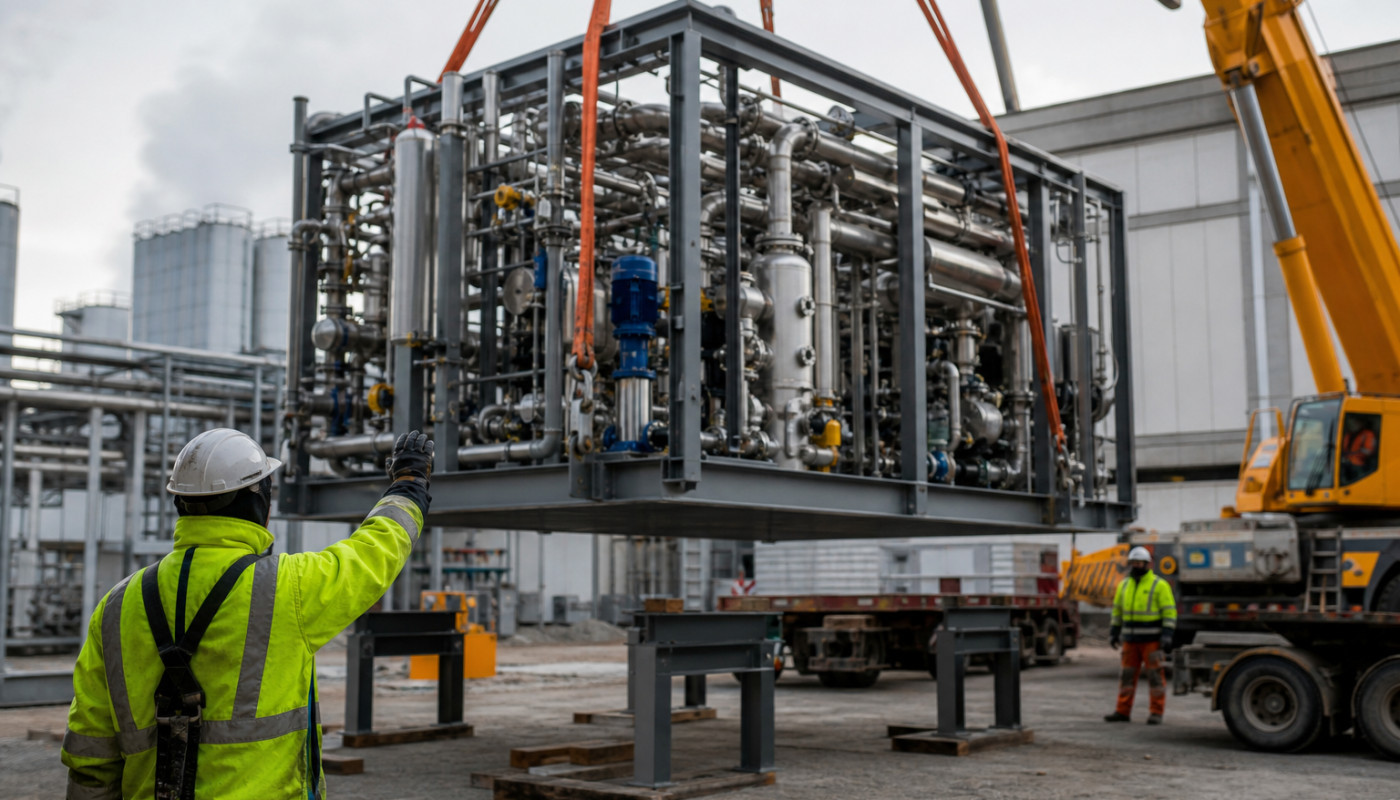
Transport and lifting are often cited as the tradeoff, and it is true that modules add constraints: road limits, crane capacity, rigging plans, and sometimes special permits. Yet those constraints are at least knowable and manageable, and they can be engineered into the package early. The alternative, improvising fit-up in the field, can create hidden delays that appear only when commissioning teams are already mobilized and budgets are under scrutiny. With skids, dimensional control and pre-fit checks are done before delivery, which reduces the risk of discovering misalignments at the worst possible moment, right before startup.
This is also where digital tools matter. Many skid programs now rely on detailed 3D models, laser scans of existing plants, and clash detection that can surface conflicts early. Done properly, that modeling discipline supports fabrication and installation planning, because spools, supports, and cable routing are defined with tighter tolerances. The result is less “field engineering” under time pressure. The real efficiency story, in other words, is not only modular hardware, it is a modular process, design decisions made earlier, tested sooner, and installed with fewer unknowns.
Quality and safety: the hard metrics
Efficiency is meaningless if reliability drops. That is why the quality case for skids tends to resonate with operations and maintenance teams, the people who inherit the asset once the project team leaves. In a controlled fabrication shop, welds are inspected with consistent methods, pressure tests are documented, instrumentation is loop-checked under stable conditions, and assembly steps follow repeatable work instructions. That discipline can reduce defects that are otherwise introduced by rushed field work, shifting crews, or difficult site conditions such as heat, cold, humidity, and limited access.
Safety improvements are often framed as a “nice to have,” yet they can be quantified. Off-site fabrication reduces the amount of work performed at height, limits hot work inside operating plants, and cuts the exposure hours that drive incident probability. The U.S. Occupational Safety and Health Administration has long highlighted how controlling the work environment and reducing congested, multi-employer jobsite activity can lower risk, and modularization aligns with that logic by moving complex assembly into safer, purpose-built facilities. For industrial operators, fewer incidents also mean fewer schedule disruptions, fewer investigations, and more stable labor relations, all of which show up in the real cost of executing projects.
Commissioning quality can also improve because skids enable factory acceptance tests that go beyond paperwork. A module can be energized, instrumented, and run through functional checks before it ships, which makes failures more predictable and easier to correct, because spare parts, tooling, and subject-matter experts are already on hand. Compare that with on-site commissioning in a tight shutdown window, where a single missing fitting or a miswired instrument can burn hours that cannot be recovered. The industrial world has learned, sometimes painfully, that startup delays are among the most expensive delays of all, because they hit revenue directly.
None of this happens automatically. Skids can fail to deliver if documentation is weak, if interfaces are poorly defined, or if the owner’s standards are not embedded into the fabrication process. That is why experienced programs emphasize traceability: material certificates, weld maps, test records, calibration sheets, and as-built drawings that match what was actually fabricated. The more modular the plant becomes, the more it depends on accurate configuration management, because maintenance and future expansions rely on knowing exactly what is inside each packaged unit.
Standardization is reshaping procurement and upgrades
The biggest shift may be organizational, not mechanical. Skid solutions encourage companies to think in platforms, standard blocks of process capability that can be purchased, duplicated, and upgraded with less bespoke engineering each time. That mindset changes procurement: instead of buying discrete components and paying for field assembly, owners increasingly evaluate complete functional packages, with clearer performance guarantees, defined testing scopes, and shorter installation windows. It also changes how plants plan upgrades, because capacity can be added by inserting or swapping modules rather than rebuilding systems in place.
For manufacturers, this can unlock new ways to manage risk. Fixed scopes are easier to price when boundaries are clear, and skids help clarify boundaries. They define what is inside the package, what must be provided by the site, and where the tie-ins occur, which reduces gray areas that often lead to change orders. That clarity can improve budget predictability, a major concern in an era when industrial projects face inflationary pressure on materials and services. It can also support faster supplier qualification, because owners can compare packaged solutions against standardized criteria: footprint, throughput, utilities, control integration, documentation quality, and lead time.
Skids are also becoming more relevant because industrial footprints are changing. Many sectors are shifting toward smaller, more distributed production, whether for resilience, proximity to customers, or regulatory reasons. Distributed sites often have less space, smaller project teams, and fewer specialized contractors on hand, which makes “install-ready” packaged units more attractive. When a facility is in a constrained location, or when expansion must occur without a lengthy shutdown, a skid’s ability to arrive largely complete becomes a strategic advantage rather than merely a construction preference.
Platforms and hubs dedicated to packaged systems have emerged to support this demand, connecting design, fabrication, and integration workflows under one roof. For readers tracking how industrial execution models are evolving, it is worth seeing how suppliers present modular capabilities and documentation expectations; a representative example can be found On aventech, where the focus is on skid approaches and packaged integration rather than component-by-component procurement. The broader point is clear: as plants chase efficiency, the winners will be the organizations that treat modularization as a disciplined operating model, not a one-time construction tactic.
Planning your next project window
For operators considering skid-based upgrades, the practical first step is to map the shutdown window and define interfaces early, then reserve fabrication capacity as soon as the scope is stable. Budgets should include transport, lifting, and commissioning resources, and teams should ask about available incentives for energy efficiency, electrification, or process modernization, which can materially offset capex depending on the region and program rules.
Similar articles

From Prompt To Masterpiece: Decoding Ai-generated Images

How Online Gaming Technologies Enhance User Experience?

Exploring The Technology Behind Effective DDoS Mitigation Solutions

Exploring the rise of quantum computing in modern industry

Exploring The Benefits And Applications Of Generative AI In Various Industries

Exploring The Benefits Of Integrating A Cutting-edge AI Chatbot Into Your Business

Exploring The Impact Of AI On Traditional Graphic Design Practices